AFTR
6 CE hrs
Coming soon
2026 Annual Federal Tax Refresher (AFTR)
The six-hour refresher and 100-question comprehension test
The full six-hour refresher every non-exempt preparer needs for the AFSP Record of Completion, built to the IRS Publication 6079 outline: new tax law and inflation figures, the general 1040 review, and preparer practices and procedures. Includes the 100-question timed comprehension test required by the IRS.
- New tax law and recent updates for tax year 2026 and the 2027 filing season.
- Domain 2 — general income tax review across income, deductions, credits, and computation
- Domain 3 — preparer practices, procedures, ethics, and e-file requirements
IRS program no. YFSXX-A-00010-26-S
The 2026 AFTR remains in IRS review and is not available for purchase. Email [email protected] for release information. Enrollment buttons currently open our contact page.
Federal Tax Law
2 CE hrs
Best seller
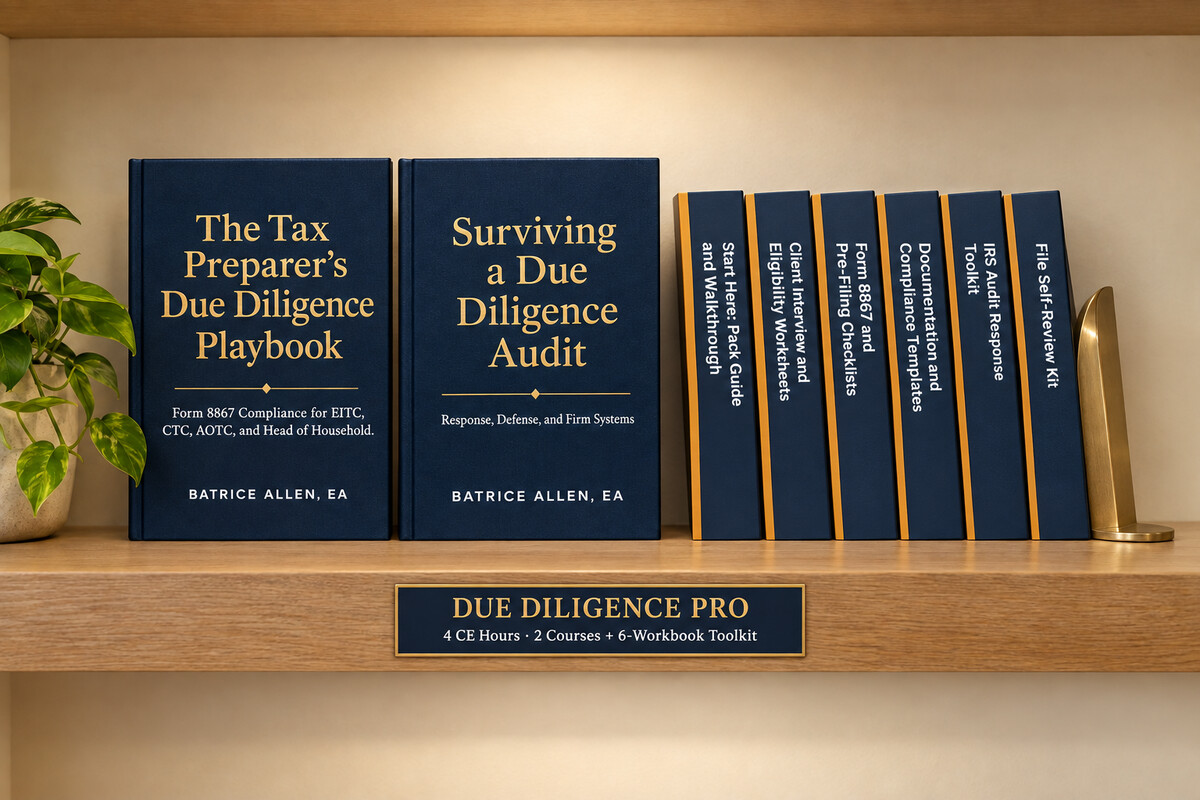
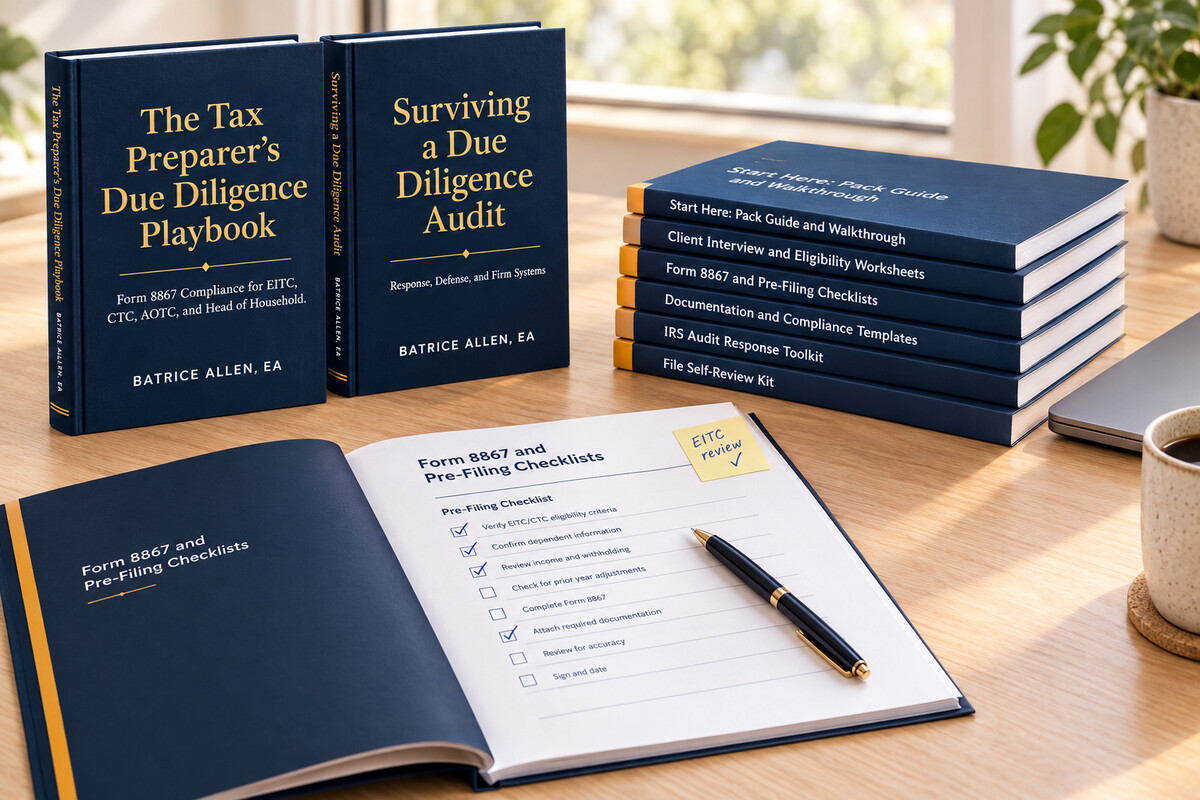
Preparer Due Diligence
Form 8867 compliance for EITC, CTC, AOTC, and Head of Household
The line-by-line anatomy of Form 8867 and the four due diligence requirements of Treas. Reg. §1.6695-2 that apply to every return claiming EITC, the CTC family, AOTC, or Head of Household. Built around the $650-per-failure penalty and what it actually takes to document your way out of one.
- Form 8867 line by line, the three submission paths, and the five-item recordkeeping rule
- Credit-by-credit eligibility deep dives plus the IRS's three published Schedule C scenarios
- Firm-level compliance program design under §1.6695-2(c) and the §6695(g) penalty regime
IRS program no. YFSXX-T-00001-26-S
Ethics
2 CE hrs
Satisfies AFSP ethics
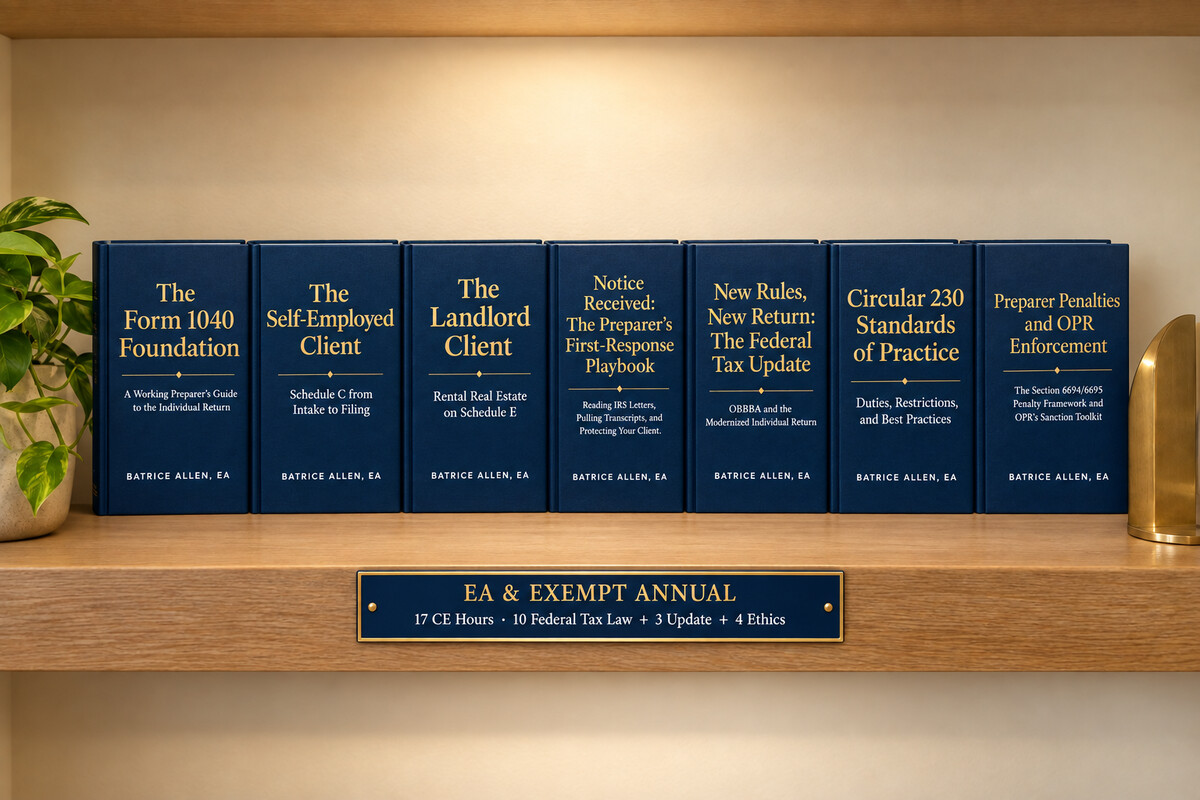
Circular 230 Standards of Practice
Duties, restrictions, and best practices
Twelve chapters through Subparts A and B of Circular 230 as in effect for 2026 — the duty to furnish information, diligence as to accuracy, the duty to advise clients of errors, fee and advertising restrictions, conflicts of interest, and client records. Closes with a five-question ethical decision framework you can apply to a live situation.
- Practice before the IRS, the duty to furnish information, and diligence as to accuracy
- Fee restrictions, advertising and solicitation rules, conflicts of interest, and client records
- Where Circular 230 duties overlap Title 26 preparer penalties, plus a five-question decision framework
IRS program no. YFSXX-E-00004-26-S
Preparer Penalties and OPR Enforcement
The §6694/§6695 penalty framework and OPR's sanction toolkit
The two enforcement tracks a preparer actually faces: the Title 26 penalty regime under §§6694, 6695, 6700, 6701, 6713, and 7216, and the Office of Professional Responsibility's Circular 230 disciplinary process. Covers OPR's sanction ladder from private reprimand through disbarment, and how a file gets referred in the first place.
- Reasonable basis and substantial authority under §6694(a); the willful and reckless standard under §6694(b)
- The seven assessable penalties under §6695, plus §§6700, 6701, 6713, and 7216 exposure
- OPR jurisdiction, referral sources, the sanction ladder, burden of proof, and reinstatement
IRS program no. YFSXX-E-00005-26-S
Surviving a Due Diligence Audit
Response, defense, and firm systems
What to do when Letter 1125 has already arrived, and what to build so it does not arrive again. Part one is a crisis-response manual through Form 5816, reasonable cause, and Appeals; part two builds the written procedures, file-review protocol, and escalation ladder that keep a multi-preparer office defensible.
- Anatomy of Letter 1125, completing Form 5816, and structuring a penalty abatement request
- The reasonable cause defense, the audit-to-Appeals timeline, and Fast Track Settlement eligibility
- Aggregate §6695(g) exposure, written procedures under §1.6695-2(b)(3)(ii), and a four-touch file review
IRS program no. YFSXX-T-00006-26-S
Federal Tax Law
3 CE hrs
Start here
The Form 1040 Foundation
A working preparer's guide to the individual return
The complete individual return in the order a preparer actually works it — intake and engagement, filing status, dependents, source documents, the Schedule 1-2-3 walkthrough, the deduction decision, credits, and e-file signature under Form 8879. The strongest single course for a seasonal hire's first season.
- Intake, engagement letters, filing status under IRC §2, and the dependency tests under §§151 and 152
- Reading W-2s, the 1099 and 1098 families, and Schedule K-1; income and the Schedule 1, 2, 3 walkthrough
- Standard vs. itemized, tax computation, the credit landscape, Form 8879, and post-filing duties
IRS program no. YFSXX-T-00007-26-S
Federal Tax Update
3 CE hrs
2026 season critical
New Rules, New Return: The Federal Tax Update
OBBBA and the modernized individual return
The One Big Beautiful Bill Act's individual income tax changes in the order you have to apply them this season: the new standard deduction and brackets, SALT cap phase-down, the senior deduction, and the new tip and overtime deductions under IRC §§224 and 225. Includes the software behaviors and override traps that come with each.
- What OBBBA changed, which provisions reached back into 2025, and how Rev. Proc. 2025-32 interacts with it
- Standard deduction and brackets, SALT phase-down, senior deduction, tip income, and overtime pay
- The CTC's permanent structure, 2026 retirement and HSA limits, and intake changes your office should make
IRS program no. YFSXX-U-00008-26-S
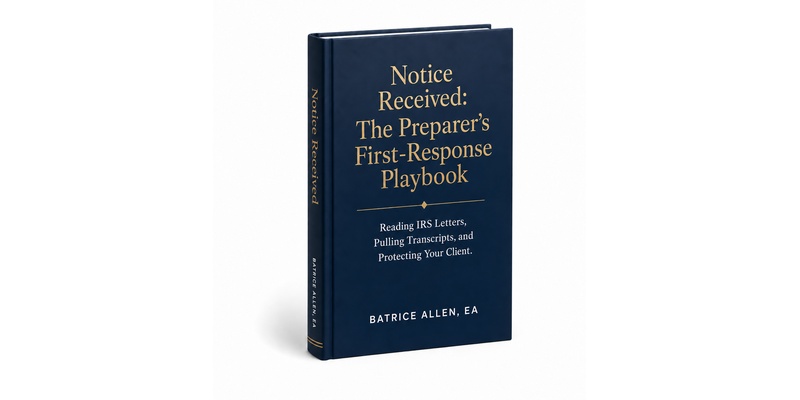
Notice Received: The Preparer's First-Response Playbook
Reading IRS letters, pulling transcripts, and protecting your client
The complete first-response workflow for the moment a client's IRS notice lands on your desk: classify the CP or LT notice, handle identity verification and IP PINs, read an account transcript's transaction and cycle codes, and run the refund-delay, collection, and exam tracks to a close.
- Notice classification, Letters 5071C/4883C/5747C identity verification, and the IP PIN program
- Transcript literacy — transaction codes, cycle codes, retrieval channels, and authorization forms
- Refund delays, CP14 through LT11 collection, CP2000 through CP3219A exam, and TAS criteria
IRS program no. YFSXX-T-00009-26-S
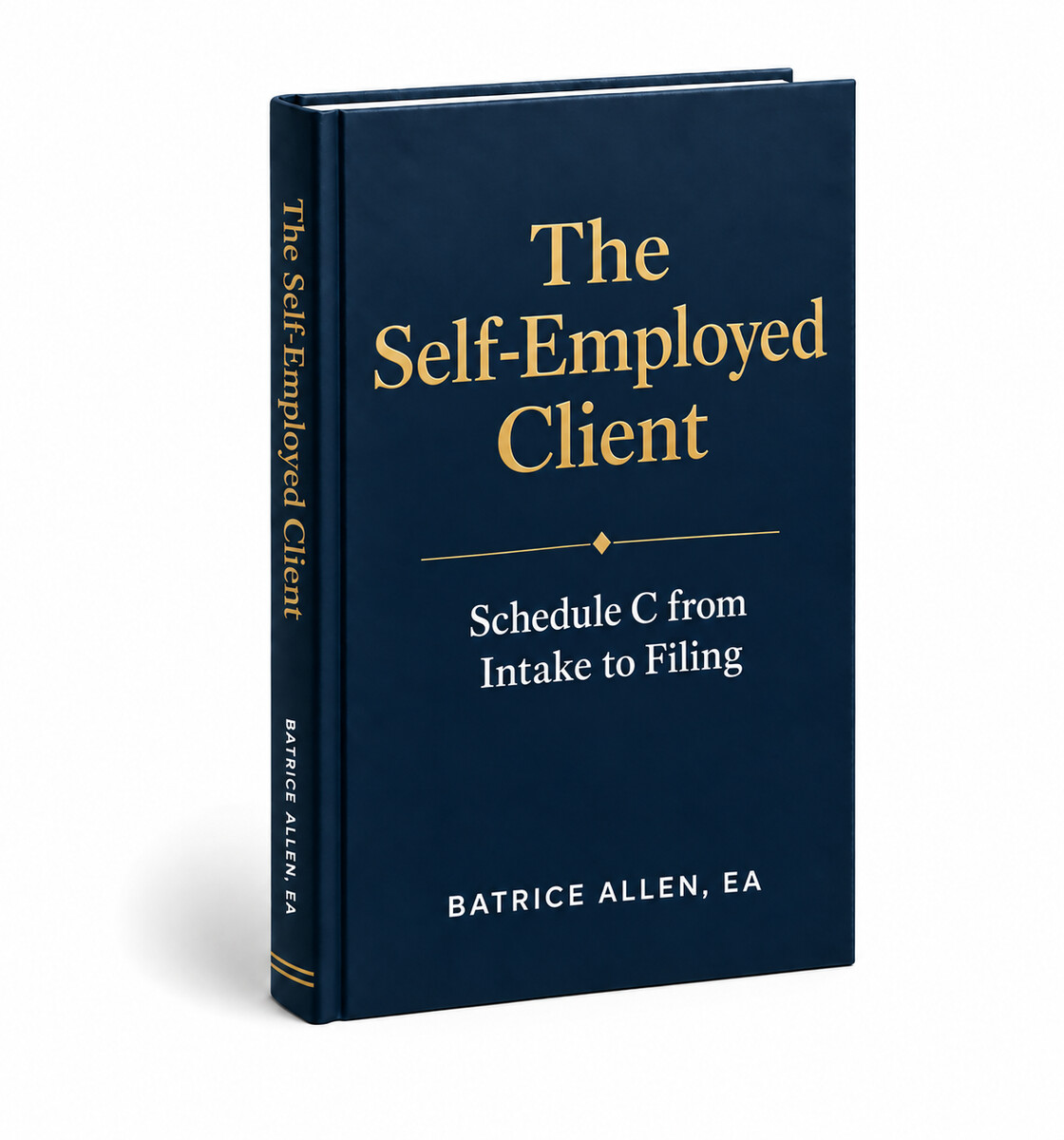
The Self-Employed Client: Schedule C from Intake to Filing
Finding the income, building the deductions, and finishing the return
Follow a self-employed client from a phone full of payment records to a completed return. Twelve chapters walk through business status, income reconciliation, deductible expenses, vehicles, home offices, inventory, and depreciation, then bring Schedule C, self-employment tax, and the qualified business income deduction together with worked examples and practical office steps.
- Business versus hobby, worker classification, and reconciling cash, app payments, and Forms 1099
- Expense substantiation, vehicle and home-office deductions, inventory, and depreciation
- Schedule C and Schedule SE, the QBI deduction, estimated payments, and pre-filing checks
IRS program no. YFSXX-T-00011-26-S

The Landlord Client: Rental Real Estate on Schedule E
From the first rental receipt to a defensible Schedule E
Follow a landlord with a former home turned rental and a room rented to short-term guests. Ten chapters teach how to classify the activity, establish basis, report rent, separate repairs from improvements, and calculate depreciation. Worked examples carry the properties through personal-use rules, passive losses, and the tax consequences of a sale.
- Schedule E versus Schedule C, converted-property basis, rental income, and expense allocation
- Repairs versus improvements, depreciation, vacation homes, and personal-use days
- Passive activity losses, real estate professional rules, rental QBI, and sale-related tax issues
IRS program no. YFSXX-T-00012-26-S





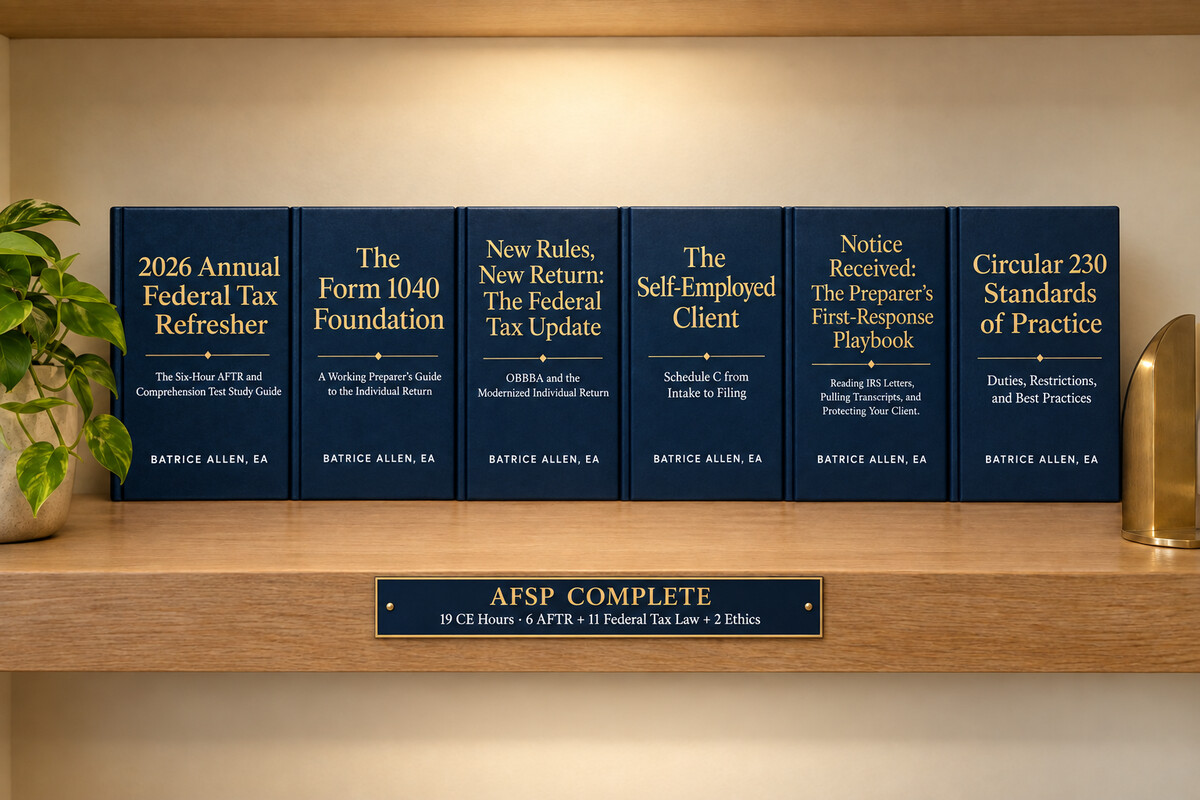 Most popular